

GovPurchase Total Market Intelligence Solutions for National Security and Defense Spending
$763 Billion Annual Federal Budget
The U.S. military budget is $763.9 billion for FY 2016. That makes defense spending the second largest Federal government expenditure, after Social Security ($938 billion). Military spending is greater than Medicare ($583 billion), Medicaid ($351 billion), or the interest payment on the debt ($283).
Defense Spending is also more than the three next largest non-security departments combined: Health and Human Services ($79.9 billion), Education ($70.7 billion) and Housing and Urban Development ($41 billion).

Defense Department Base Budget
If all military spending could somehow be safely eliminated, there would be a budget surplus of $255.6 billion, instead of a $474 billion budget deficit.
The true cost of military spending includes all of the following:
- $534.3 billion for the base budget of the Department of Defense (DoD).
- $50.9 billion for Overseas Contingency Funds for DoD and the State Department to fight ISIS.
- $178.7 billion for defense-related agencies and functions. This includes the Department of Veterans Affairs ($70.2 billion), the State Department ($46.3 billion), Homeland Security ($41.2 billion), FBI and Cybersecurity in the Department of Justice ($8.4 billion), and the National Nuclear Security Administration in the Department of Energy ($12.6 billion).
DoD requested $534.3 billion, a 7.7% increase over last year’s base budget of $496.1 billion. It seeks to:
- Raise everyone’s pay by 1.3%. If you include subsidized housing, free healthcare and the other benefits military personnel receive, the average compensation works out to $59,000 for enlisted personnel and more than $108,000 for officers.
- Maintain a limited counterterrorism force in Afghanistan, and train local military.
- Train local security forces in Iraq and Syria to combat ISIS.
- Strengthen maritime security in Asia. Pay more attention to al-Quada in Africa.
- Increase presence in NATO to respond to Russia’s aggression in Ukraine.
- Beef up cyber security forces. Focus on nuclear deterrence by spending more on the nuclear weapons complex and on nonproliferation.
- Lower spending with the Better Buying Power (BBP) initiative.
- Despite prior promises to reduce spending on the F-35 Joint Strike Fighter, or eliminate the program completely, an additional $10.6 billion is being budgeted to move the program forward. (Source: Defense Department FY 2016 Fact Sheet, Jonathan Berr, Pentagon’s Too Big to Fail Gets Another $10.6 Billion, Fiscal Times, February 2, 2015)
U.S. Military Spending vs. the World
The U.S. outpaces all other nations in military expenditures. World military spending totaled more than $1.7 trillion in 2013. The U.S. accounted for 37 percent of the total.
U.S. military expenditures are roughly the size of the next nine largest military budgetsaround the world, combined.
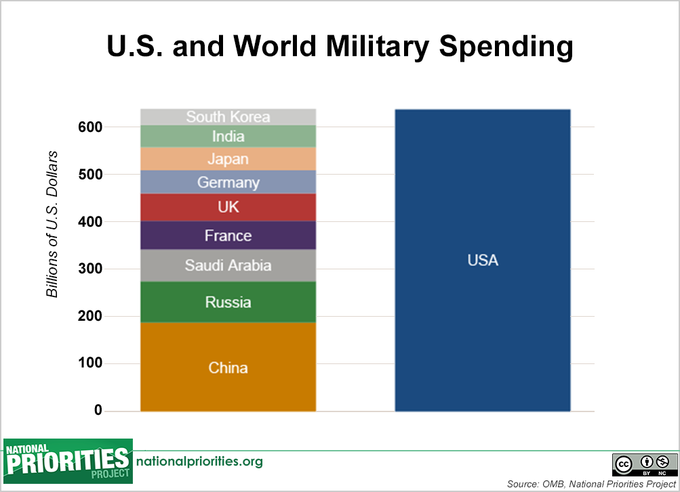
U.S. military spending dwarfs the budget of the #2 country – China. For every dollar China spends on its military, the U.S. pends $3.60.
Need Specific Contracting Intelligence on This Topic?
Our procurement analysts track active solicitations, contracting officer emails, and upcoming recompetes for your specific industry.
Connect with a GovPurchase Specialist
Receive matched contract solicitations and buyer intelligence for GovPurchase Market Intelligence on Defense Spending.